Black History Month – How erasing death erases history.

I thought for black history month I might present some of the black segregated cemeteries and why they are hard to find.

This is 1440 Forest Ave. in Staten Island New York. This is where an estimated 1000 people of color have been buried. Only 50 of the actual graves have been recorded but none of the graves have been moved.
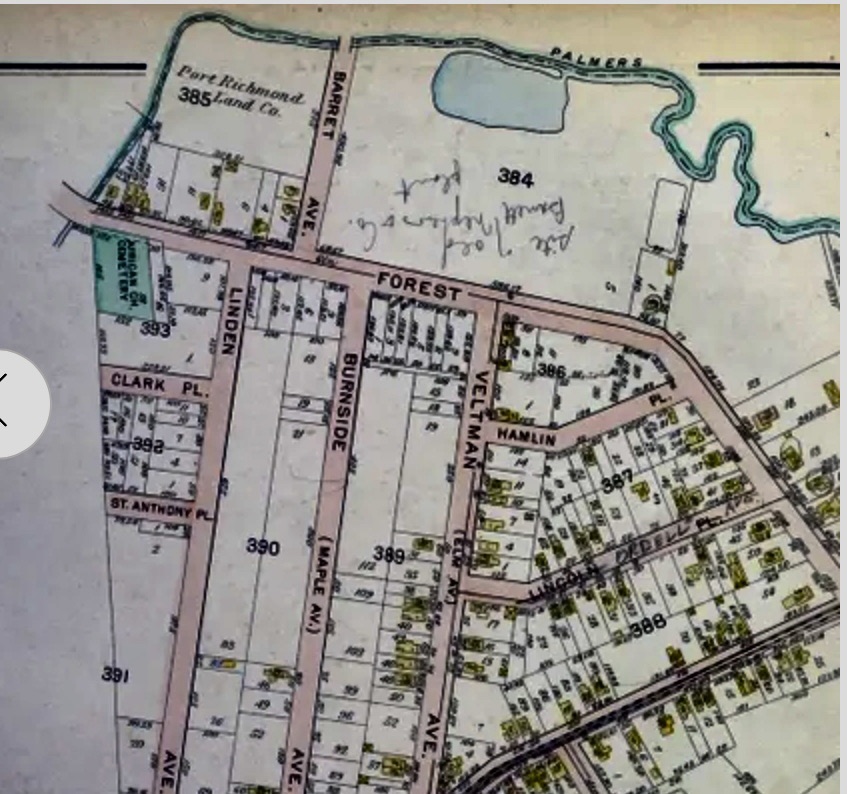
Lot 384 is where the church and cemetery once existed. The church gone but not the cemetery

This slave and free folks cemetery was owned by the Second Asbury African Methodist Episcopal Church. The cemetery was made up of homemade wood crosses and stones that would mark a grave. The church was burned down by vandals in the late 1800s and the remains wood from the church was taken piece by piece. Eventually the graves were vandalized and one would be hard pressed to recognize it as a cemetery by 1920. The last person buried within the cemetery was in 1916. Perhaps you know of a cemetery with people buried in the 1800s that is still marked s a cemetery?

Along come some wealthy white land developers which tell the city that the land can’t be tax exempt because it’s not a cemetery, to them it didn’t look like one. The white city leaders agree and the land has a new tax debt of $11,000.00 that the board of the church did not receive until after the tax sale of the land happened.

The owners gave a donation to the Negro College Fund saying they had no idea it was a cemetery. Of course this happened after buildings were placed there. Ownership would change over the years but never any mention of remains dug up for which there had to be some. A strip mall was built by the third set of owners but when approached they refused a monument to mark the history of the cemetery. A plaque was finally put up but has since been removed.

Unfortunately there are very few records of slave burials or free folks of color burial records due to disrespect of others, land sold and bought with graves on the land. People of color didn’t own land and wouldn’t for another sixty plus years. They had no bargaining power over their own ancestors graves or their own deaths for that matter. That history and that knowledge of who came before them had been destroyed forever.

Mourning Rings

The Victorian Age was the period of 1860-1902. This historical time was named after Queen Victoria. In America this was time before the industrial boom and after the Civil War.

Queen Victoria mourned her husband Prince Albert for over 20 years and the Civil War created nationwide grief and mourning rings became a part of grief fashion. It was expected that a woman would were black when in mourning for two years with the loss of a husband, parents were one year, and the death of a child was usually a year of black clothing.

Along with the black clothing black jewelry was also worn. Mourning jewelry was advertised as such and all necklaces, bracelets, and pins were black. Mourning rings were more personal than most mourning jewelry in that it would be engraved with the date of death, a small lock of hair would be incorporated into the ring, forget me nots, doves, or hearts were often themes of these rings.

Mourning rings made a short comeback in the late 1930s and early 1940s. Today they aren’t referred to as mourning rings but often people choose to have their loved ones ashes added to a creation which can include a ring, necklace, bracelet, and almost anything else you can imagine.

Death in another century

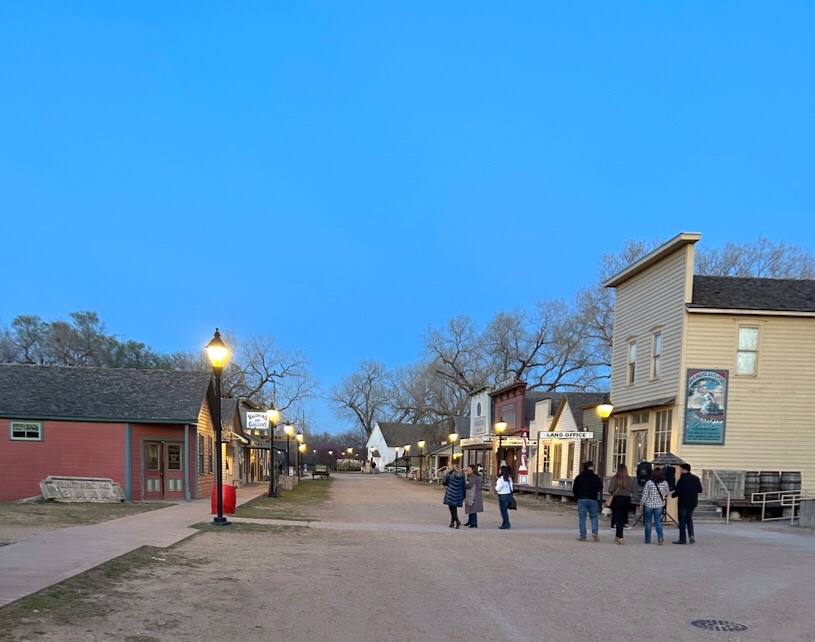
We have a “cowtown” museum in the city I live. The museum has building g duplicates of the original city as it stood in the late 1890s. You can walk into each store , shop, house, or farm as it stood over 100 years ago. It’s what I would call an interactive museum. I really enjoy Cowtown and they always hold interesting historical events.

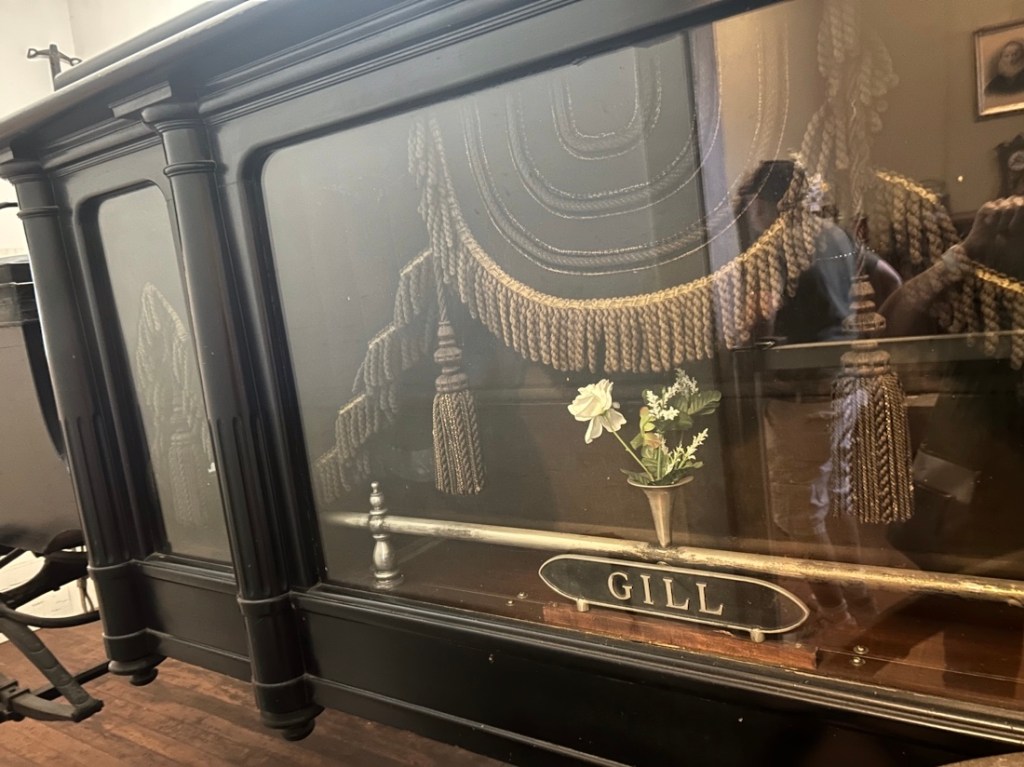
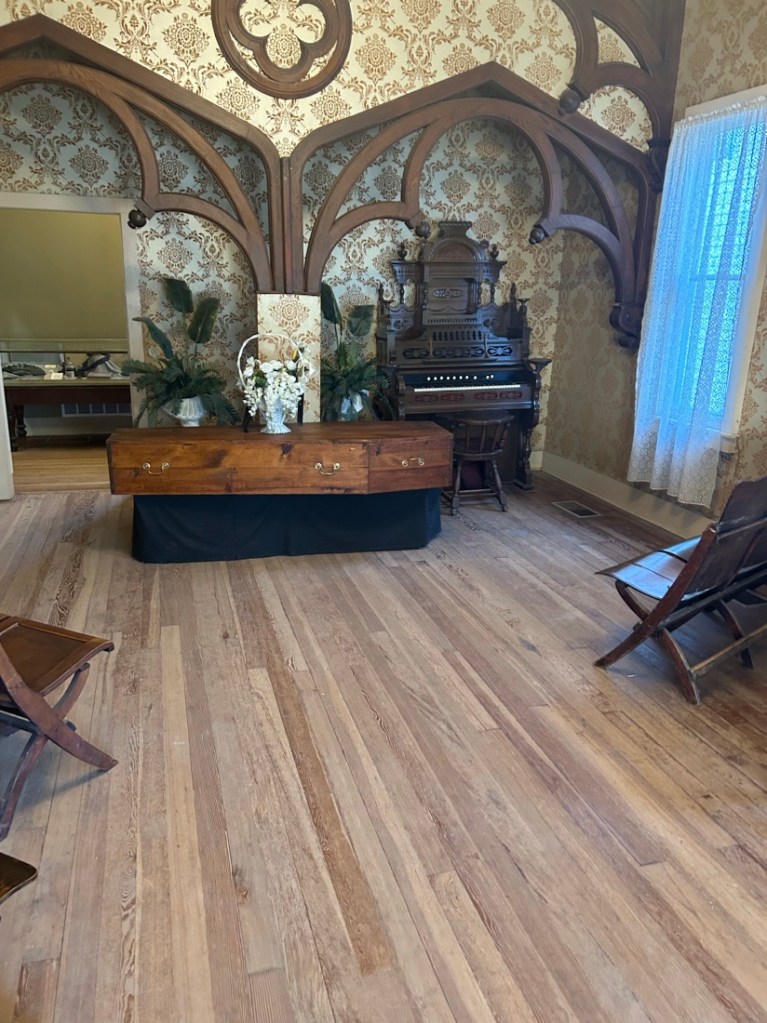
Like any museum Cowtown is a living , growing learning experience. I have been to Cowtown many, many times in my years of living in the city I was born and grew up in. I have never noticed the undertaker business until last week. Cowtown has about 50+ buildings and recreations on their grounds and I have never noticed the undertaker before. Below are some pictures I took that shows how death was treated in the years after the Civil War.

Cowtown Museum
Gill Mortuary was the first in Wichita KS
A typical coffin in Midwest 1890s
Where services were held in the mortuary
A grim reminder of high child mortality in the 1800s.
A full view of the viewing room, funeral service room, and viewing room all in one, complete with organ.

Kansas Country Cemetery #3

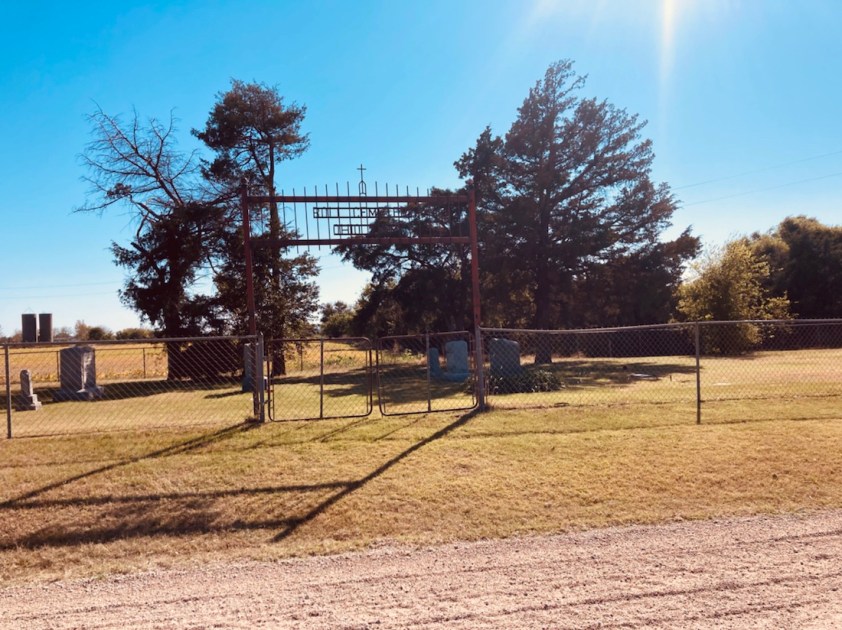
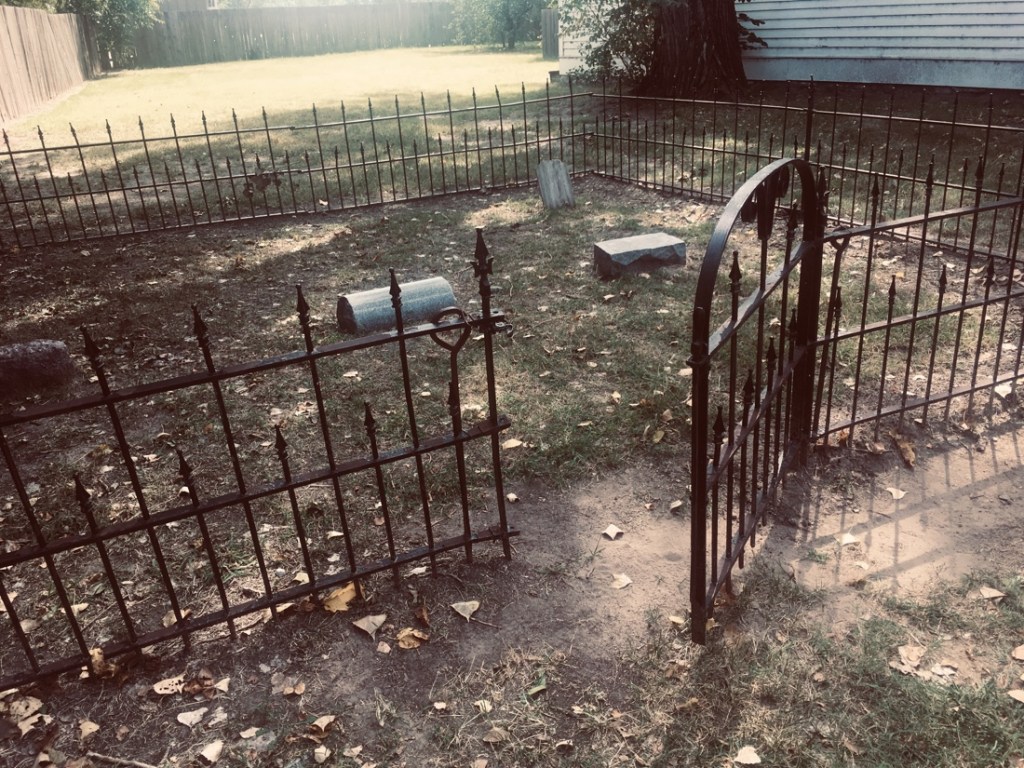
Like all of the cemeteries I will be posting, Roll cemetery , once way outside the city limits, is well within the city limits of Haysville, KS. Now Haysville KS is butt up against Wichita KS. You don’t realize you have left one and entered the other. I have blogged before my curiosity comes from my business , content for this blog, and the YouTube channel Sidestep Adventures. Kansas doesn’t have as long of a history as the state of Georgia which is where Sidestep Adventures takes place, but the history can be found in its small country cemeteries. This is Roll Cemetery and the Roll family is buried within. Family cemeteries were very common in the 1800s to early 1900s and Roll Cemetery displays that history well.

Roll Family Cemetery in Haysville KS.

Like the others I have posted Roll Cemetery has a beautiful handcrafted entrance and is well cared for. The fence came years later to keep others out and to mark the area which is designated as cemetery.

The fence is there although the cemetery will never fill the land.

Roll cemetery is on about an acre of land but runs along the side the dirt road and it’s length is greater than it’s width.

This is my favorite view of Roll Cemetery. The hand crafted iron gateway is simple but stark
against the Kansas Prairie.

#2 Kansas cemeteries you may never see

In my last post I wrote about my inspiration for posting pictures and comments about Kansas cemeteries. Not the huge mid century cemeteries and their big Masoleums or the newer cemeteries with flat markers, big statues and biblical names for each section. My inspiration is a YouTube channel called Sidestep Adventures. On this YouTube channel they take you through Georgia and Alabama cemeteries that many don’t realize exist and are so old they aren’t even mapped.

I’m starting in my own county of Sedgwick in the state of Kansas. Prairie cemeteries mark the harsh realities of what life was like in the early to late 1800s. The cemeteries are small and some of them are no longer hidden due to urban sprawl. Marked in stone is the life the prairie provided for the first that settled Kansas.

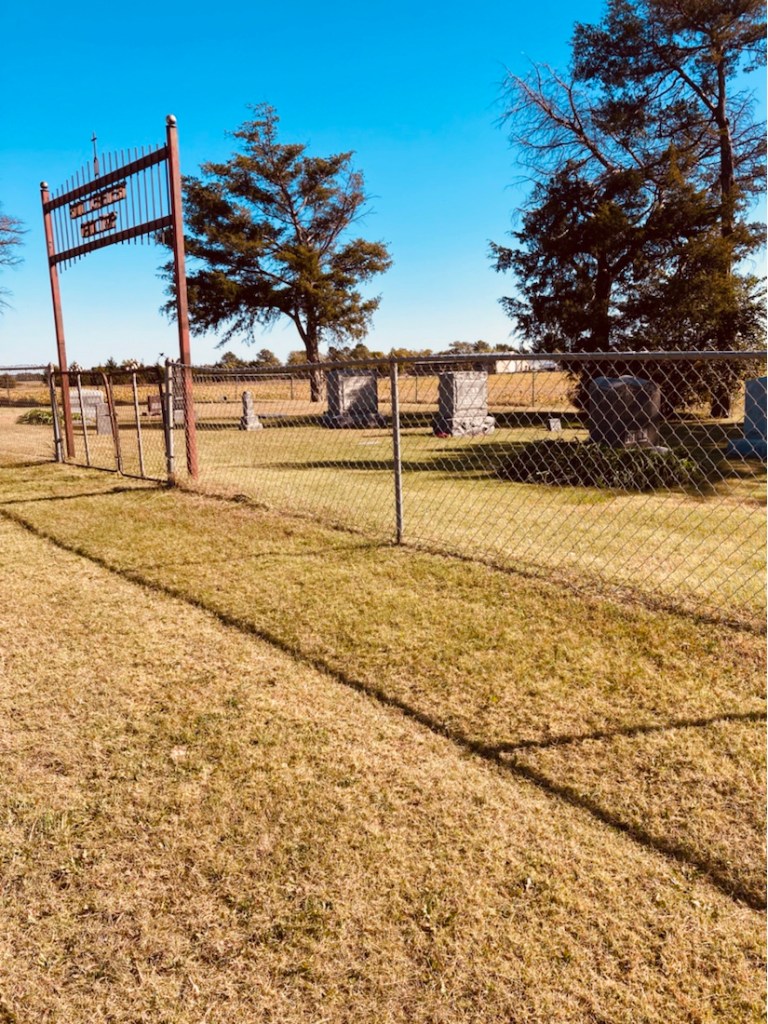
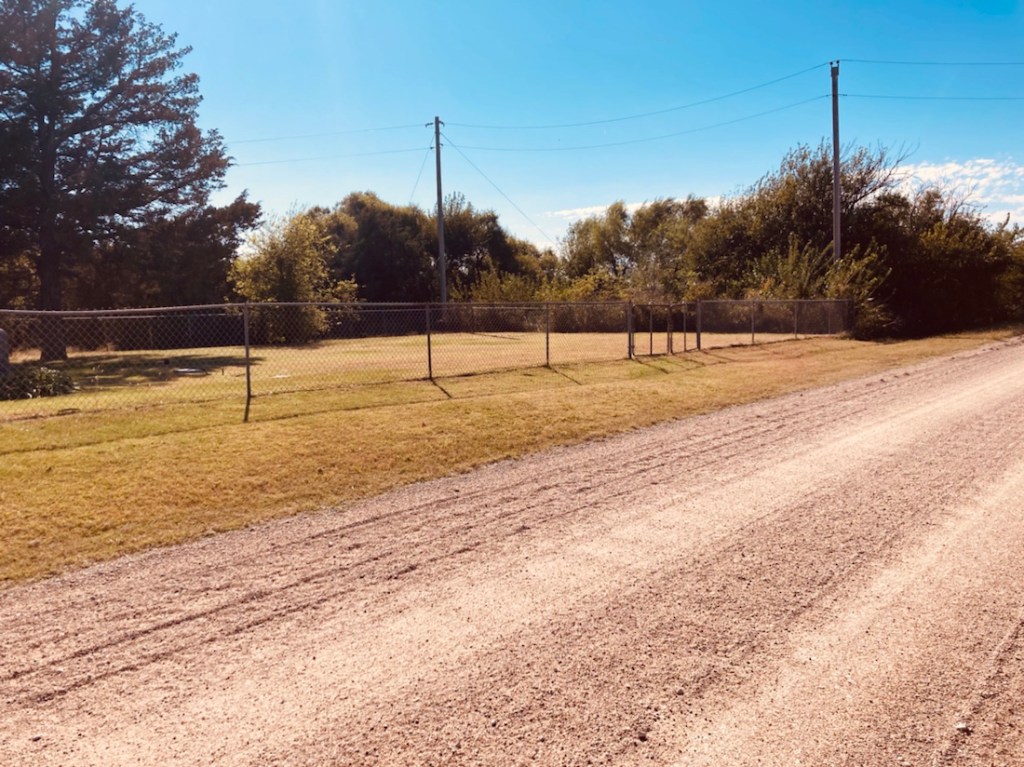
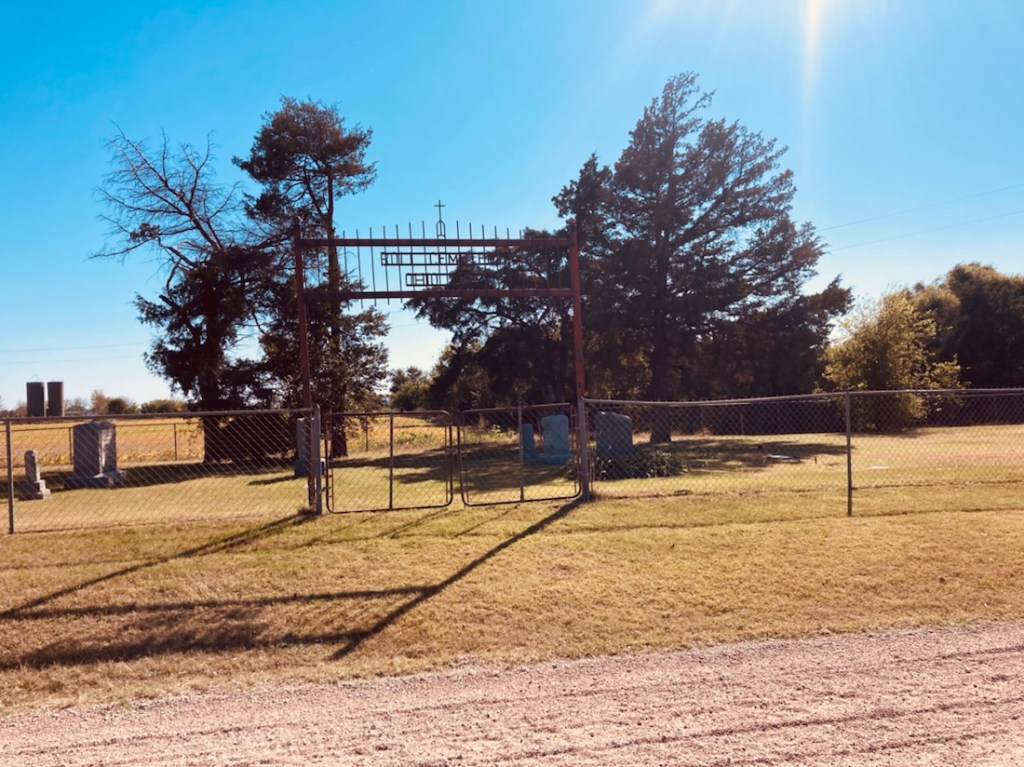
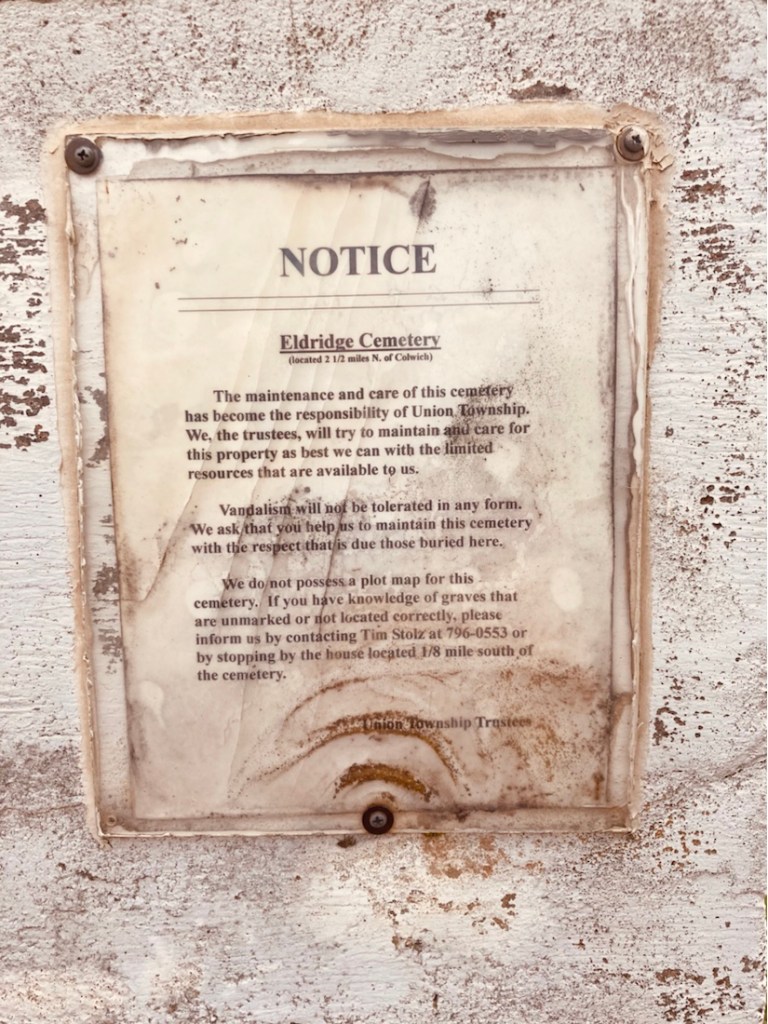
These pictures are of Eldridge Cemetery near Colwich KS. This is a farming community outside of Wichita KS. Colwich was once miles outside of the city but today is only 7 miles away from Wichita. There is no one named Eldridge buried here. The first grave that I could find belonged to a child named F. Arthur , age 1 year- 9 mos. Little Arthur is laid to rest with his father who shares the same stone maker. Most of the graves are from the late 1800s to the very early 1900s with very few exceptions. The majority of the graves are of infants, children, and young adults, with their parents following in death. There is one small mausoleum building with no identification of its owner. The cemetery is well groomed and some flowers were placed at one grave. The legacy of this Kansas cemetery seems to be the hard life of early farming in Kansas.

The cemetery is spread over about an acre of land
The notice tells you what you need to know
The sidewalk that welcomes you into the cemetery
All of the stones are large and elaborate with children having the largest stones. The electric pole in the back of this picture is the only thing that gives a hint to a new century.

Kansas Cemeteries you may never see. #1

I follow a YouTube Chanel called Sidestep Adventures. The host takes you through the past of Alabama and let me tell you it has a lot of past to view. I’m a bit of a history buff and I find his episodes on old cemeteries fascinating. Of course Kansas doesn’t have as many historical cemeteries, slave cemeteries, plantation cemeteries as Georgia and Alabama but we do have a few hidden gems. The difference being that our Kansas cemeteries are not hidden beneath bushes, wisteria, and huge oak trees. Kansas cemeteries are of the plains. The plains of Kansas were very harsh to the settlers of the 1800s, lots of sun, wind, and dust, and not much more. I have no doubt that many of the small farm cemeteries are long gone, plowed over and forgotten. The ones that do remain are quaint and quietly taken care of. The host of SidestepAdventures would tell you the cemeteries that remain almost own themselves. In other words, if a cemetery has been photographed and reported to the county that land can’t be sold or built on, so they just work around them. I will have to check out Kansas law on cemeteries before my next post.

Here is my first attempt at showing small Kansas cemeteries on the prairie.

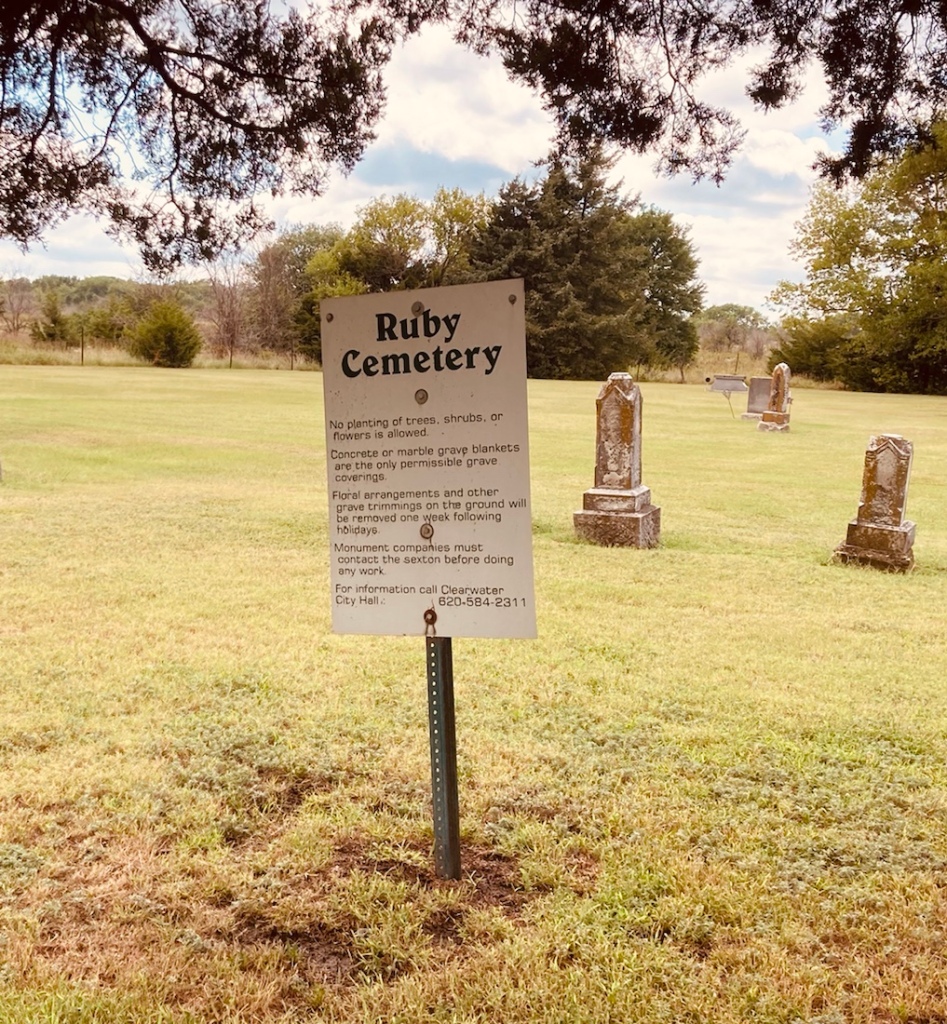
#1 RUBY Cemetery. Although this cemetery is close to Clearwater KS ( population 2500) and Wichita KS (population 400,000.) You can see by my pictures it is a prairie cemetery of years ago.

Have you ever wondered?

Now the title may fool you into believing that I just might be writing about something other than cemeteries but I’m not. I’ve been visiting cemeteries for most of my life. It started when I was around 10 my mother would let me come along on Memorial Day as she decorated graves. Her only rules were ; you can’t talk, and you can’t ask a lot of questions. My mother knew me well. I took the job over at 19 when my oldest brother died and have been visiting the resting places of my nuclear family for the last 35 years. I do have a few questions that still wonder from time to time….

Where are all the graves from the west migration in America (1865-1900) . I’m a child of the 70s and so I watched a lot of westerns in my youth and it seems to me that they buried people just about anywhere and marked with a makeshift wood cross.

I’ve learned that there are many unmarked graves of Americans and cemeteries that were sold with property were often destroyed. Many small towns that no longer exist had small town cemeteries that no longer exist. The answer , like most things in life, is not clear. It depends on how far west, how close to a town, and if the town had an undertaker, or a church cemetery. It was the Wild West and many parts of eastern civilized American life took time to reach the bold frontier. Indigenous people have been buried in American soil for thousands of years and they are the history of this nation as are the burial sites they once preserved. I do know one thing, my mother would be frustrated with me if she knew I was still pondering the same questions.

We try to create a vision of the past in little towns like this one in Wichita KS called “cowtown”. Complete with a small church cemetery.

A mother’s tears from another time

This is a story that could be told in any city that has an “old” cemetery. This is a story that has happened over and over with little notice or concern but for a fleeting moment.

In this story some “vandals” thought for whatever reason they had the right or pleasure to destroy graves in a historical cemetery where I live. First I should mention that the vandalism did not go unnoticed by the hardworking staff and the volunteers that give their time and talent to preserve this historical cemetery.

What did go unnoticed by the vandals were the dates, ages, and names of one particular headstone.  I would hope they didn’t notice and still chose to destroy the headstone, that would make them not only vandals, but lost souls.

The headstone I’m referring belonged to the Steele family. To be specific, the Steele children;

Eliza – age 4yrs. – Henry age 3yrs. – Timothy age 2yrs.

All three children died within a few days of one another in March of 1877. That year there was an epidemic of scarlet fever and the Steele children succumbed to the fever.  I can’t imagine the grief and pain this mother must have felt or the tears that continued to come that horrible month in 1877 as she lost one child ,and then another ,and another.  The monument was a way of expressing that her children were here on earth, they were part of a family, they were loved, and their deaths left a hole in their family and her heart.

A few months ago someone discovered the missing headstones in a creek on the other side of town. The headstones have been restored thanks to the work of volunteers.

I can only vision a mother who wiped her tears away with the restoration of her children’s final resting place.

UPDATE……..Can’t see the forest for the trees.

On December 11, 2016 I posted a story about a baby grave from the 1800’s that I had walked by dozens of times in the last 17 years.

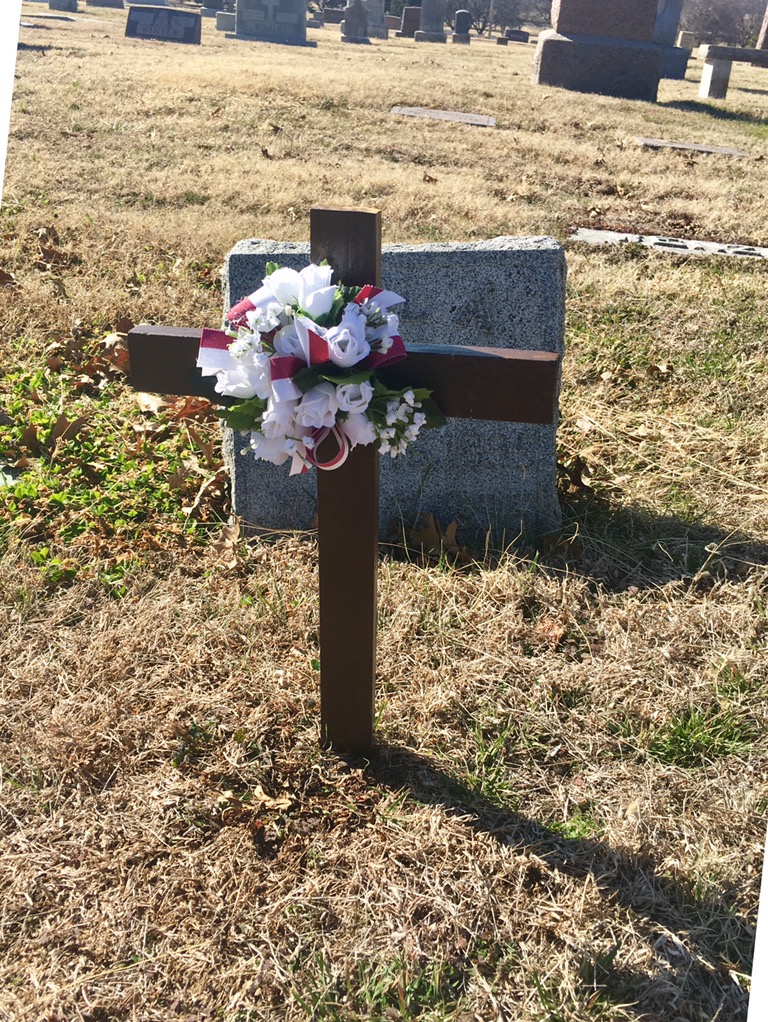
Today the weather was a beautiful 70 degrees so I went to honor baby Paul with a memorial cross.